
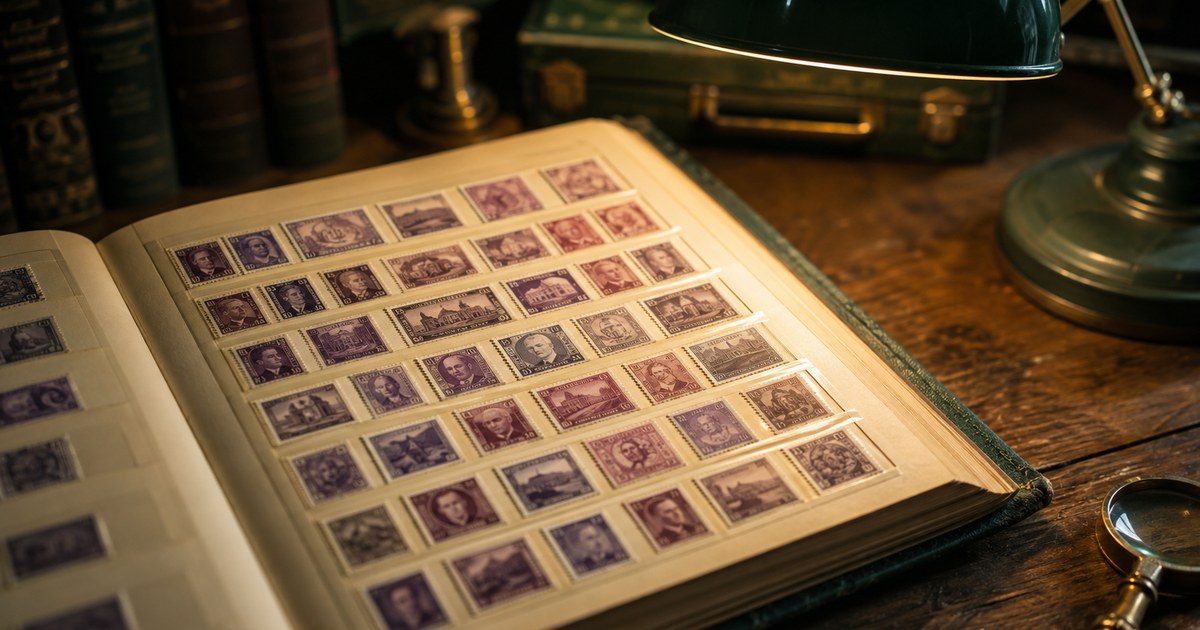
The stamp is small, a dull purple that people describe as violet or plum or maroon depending on the light, and it shows Lincoln in profile above the word FOUR. If you have inherited an American album, you almost certainly have a page of them, which is why the 4 cent Lincoln stamp value question deserves a straight answer before an optimistic one. This was the stamp that carried ordinary American mail at the end of the 1950s.
Almost every 4 cent Lincoln in an American album is Scott 1036, the red violet Liberty Series definitive issued on November 19, 1954. It became the everyday first class stamp in 1958 and survives in enormous numbers, so used copies are worth pennies, and Mystic Stamp Company retails a mint single at 40 cents (dealer retail).
The useful question is not whether yours is the rare one. It is which 4 cent Lincoln you are actually holding, because at least four different stamps answer to that description and only one narrow group of them carries a premium.
Why is the 4 cent Lincoln so common?
Because of a single date. On August 1, 1958, the United States first class letter rate rose from three cents to four cents, and as Mystic Stamp Company puts it, the Lincoln stamp “became the most widely used stamp in the country.” Every letter, every bill, every Christmas card in America needed one.
Scott 1036 was already in service by then. It was issued in New York on November 19, 1954 as part of the Liberty Series, the definitive set that replaced the 1938 Presidential Series and stayed in production into the mid 1960s, per Wikipedia’s account of the issue. A definitive stamp is designed to be printed continuously for years rather than in one commemorative run, so by the time the design was retired it had been produced on rotary presses in quantities no collector market could ever absorb.
The result is the pattern that governs almost every album in America: enormous supply, ordinary demand, prices measured in cents. The same arithmetic explains the red 2 cent Washingtons and green 1 cent Franklins sitting on the facing pages, and we work through it properly in why most stamps aren’t worth much.
What is the honest 4 cent Lincoln stamp value?
Three honest tiers, all of them dealer retail unless noted, which means these are prices a dealer asks rather than prices a dealer pays:
- Used singles. Cancelled copies are the most common survivors by a wide margin. Dealers sell them in bulk glassine envelopes of 100 or 1,000 because pricing them individually costs more than the stamps are worth. Treat a used copy as small change.
- Mint singles. Mystic retails a mint Scott 1036 at 40 cents. That is the asking price for a sound, gummed example from one of the largest US dealers, and it is roughly ten times face value for a stamp that is seventy years old.
- Full sheets and part sheets. Mint sheets of 4 cent Lincolns are still valid postage, so their practical floor is the face value of the stamps on them: a hundred stamp pane is four dollars of postage. Intact sheets do carry a collector premium over that floor, and Mystic lists a mint sheet at 35 dollars (dealer retail). Note the direction of that number, though. It is a dealer’s asking price for a clean, complete, well centred sheet, and a dealer buying yours will pay a fraction of it, which is why sheets so often change hands near face.
None of that is a disappointment so much as a correction. Search results for this stamp are dominated by listings and by pages promising that a common definitive is secretly worth hundreds. The stamps in the next section are the reason those claims sound plausible, and the reason they are almost always wrong about the stamp in your hand.
Which 4 cent Lincolns carry a real premium?
The exceptions are real, specific, and identifiable without a catalogue:
- The imperforate coil error. The 4 cent Lincoln was also issued as a coil stamp, Scott 1058, released July 31, 1958 in Mandan, North Dakota, perforated 10 vertically so it has straight edges top and bottom. A small number escaped without perforations at all. Mystic retails the imperforate pair, Scott 1058a, at 87.50 dollars (mint, dealer retail) against 90 cents for the normal mint coil. Be aware that Mystic’s own listing for 1058 records the perforations the other way round; dealer databases and the specialist Liberty Series listings put the perforations on the vertical edges, which is what you can check for yourself on the stamp.
- Booklet panes. The design was also sold in booklets. An intact pane of six, Scott 1036b, retails at 5.95 dollars at Mystic (dealer retail), and a complete unexploded booklet is scarcer still, because almost every booklet ever sold was torn apart and used. If you are working from a pre-2015 catalogue, look for this pane under 1036a instead: Scott renumbered it when it tidied up the Liberty Series listings.
- The precancelled wet printing coil. Wikipedia’s survey of the Liberty Issue singles out one item: the 4 cent coil printed by the older wet process on the Stickney press, which it says exists only precancelled and is the scarcest regularly issued key item of the whole series. A precancel is a cancellation printed on the stamp before it was sold, usually a city name between two horizontal bars.
Everything else is common. A well centred copy, a copy with bright colour, a copy with a nice postmark, a copy from a plate block: those are pleasant, and they are not rare. The premium in this issue lives in format and printing method, not in appearance.
Are the 1958 Lincoln Sesquicentennial stamps the same thing?
No, and this is the most frequent mix up in the whole topic. Between 1958 and 1959 the Post Office Department issued a separate set of four commemoratives for the 150th anniversary of Lincoln’s birth, catalogued Scott 1113 to 1116. Two of them are also 4 cent stamps, which is exactly why people confuse them with the definitive.
You can tell them apart on sight. Scott 1113 is a 1 cent green showing the beardless Lincoln of 1860. Scott 1114 is a 3 cent purple based on Gutzon Borglum’s marble head of Lincoln. Scott 1115 is a 4 cent sepia marking the Lincoln-Douglas debates, first issued at Freeport, Illinois on August 27, 1958. Scott 1116 is a 4 cent dark blue showing part of the Daniel Chester French statue in the Lincoln Memorial. None of them shows the plain profile portrait of the Liberty Series stamp.
They are also not valuable. Mystic retails the complete set of four at 1.80 dollars (dealer retail), which is under 50 cents a stamp for a set that turns up constantly in mid century albums. If a listing tells you a 4 cent Lincoln commemorative is a five hundred dollar stamp, it is either describing a certified error or describing nothing at all.
How to check yours without guessing
Work through it in this order. Look at the portrait: profile bust means the Liberty definitive, a scene or a sculpture means a Sesquicentennial commemorative. Then look at the edges. Perforations on all four sides means a sheet stamp, the common case. Two straight edges means a coil, which is where the errors live. Straight edge on one side with a pane of six means a booklet. Then look for a printed city name and bars, which marks a precancel worth a second look.
If the answer is still ambiguous, photograph the stamp with Stampo and let the app place the issue, the catalogue number, and an honest condition tiered range in seconds, instead of scrolling through listings that only show what sellers hope to get. The same drill applies to the stamps beside it in the album, from the 1 cent Franklin to the 2 cent Washington, and our United States stamp values guide covers what is genuinely scarce across the rest of the country’s issues.
The verdict on the purple one in your album: it is common, it is worth cents, and it is a stamp that carried real letters through the Eisenhower years. Check the edges before you conclude anything else.
Sources
- 1036 - 1954 4c Liberty Series: Abraham Lincoln - Mystic Stamp Company
- 1058a - 1958 4c Liberty Series: Abraham Lincoln, Imperf. Error - Mystic Stamp Company
- 1036b - 1954 4c Liberty Series: Abraham Lincoln, Booklet Pane of 6 Stamps - Mystic Stamp Company
- 1113-16 - 1958-59 Lincoln Sesquicentennial Series, Set of 4 Stamps - Mystic Stamp Company
- Liberty Issue - Wikipedia
- 1058 - 4c Abraham Lincoln, Perf 10 Vert. Coil - Kenmore Stamp Company
- 1954 Liberty Issue listing (perforation varieties) - The Swedish Tiger